The Spatial Paradigm Shift in Luxury Real Estate Pre-Sales
In 2026, an immersive VR architecture walkthrough is no longer an optional digital novelty; it serves as the foundational infrastructure for high-value off-plan real estate transactions across global markets. As high-net-worth individuals increasingly acquire multi-million-dollar residential and commercial assets remotely, traditional marketing collaterals—such as pre-rendered still images and static physical scale models—are proving insufficient. Capital allocation at this tier demands absolute spatial clarity, emotional resonance, and real-time agency over unbuilt spaces.
The convergence of Universal Scene Description (OpenUSD) workflows, real-time neural rendering pipelines, and tetherless spatial computing hardware has fundamentally altered buyer expectations. Developers marketing trophy assets in London, Dubai, New York, and Mumbai are replacing static sales suites with dynamic digital twins streamed directly to client headsets or WebGL-enabled browsers. By enabling buyers to step into an unbuilt penthouse, adjust daylighting to mimic specific seasons, and evaluate bespoke interior material assemblies in real time, spatial visualization turns abstract architectural blueprints into tangible emotional investments long before groundbreak.
How VR Walkthroughs Help Sell Off-Plan Properties Before Groundbreak
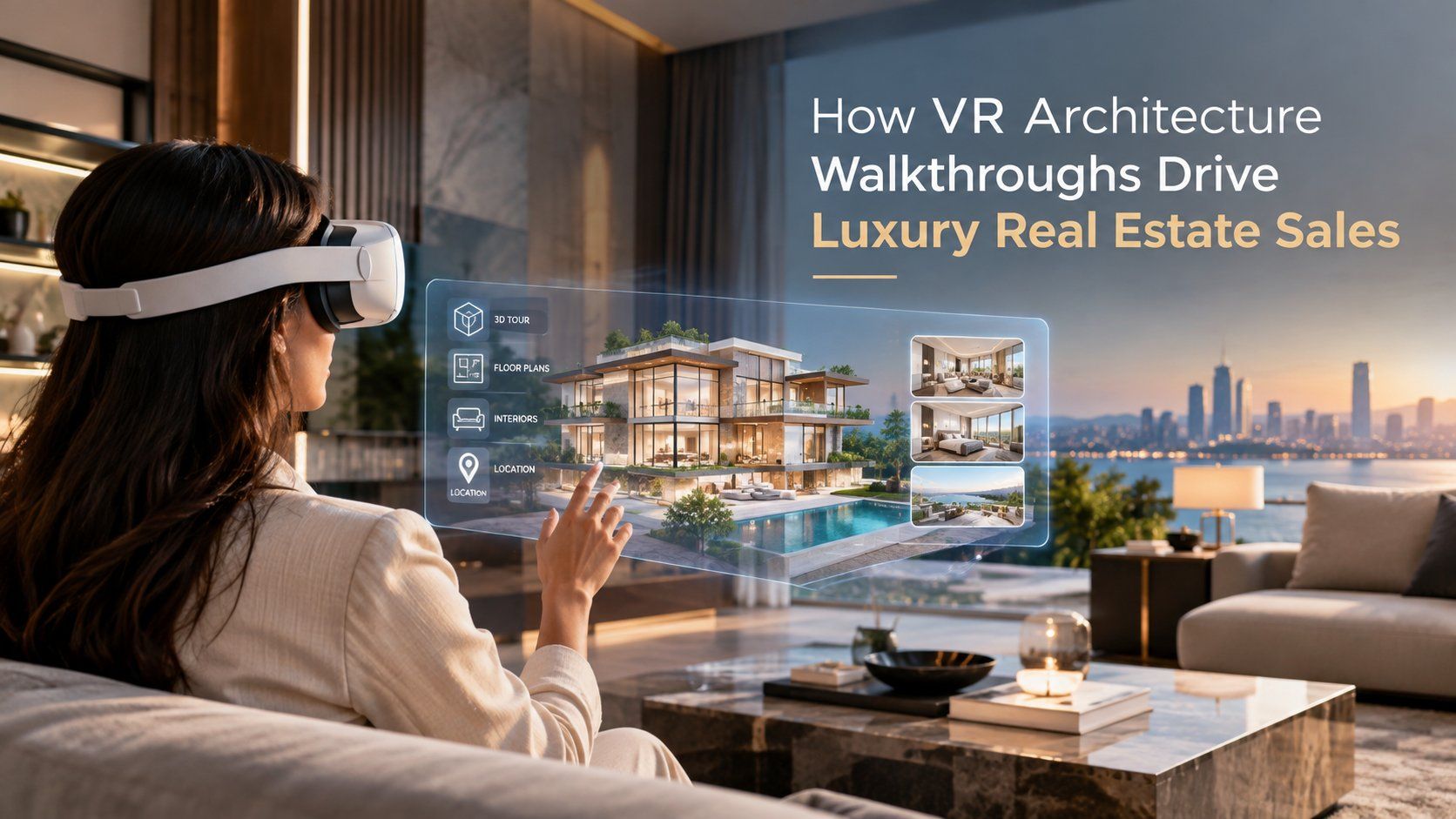
A high-fidelity VR architecture walkthrough accelerates off-plan property sales by eliminating the spatial ambiguity inherent in traditional 2D floor plans and static renderings. By placing buyers inside an accurate 1:1 scale environment, spatial computing bridges the gap between architectural intent and client perception, allowing purchasers to evaluate ceiling heights, sightlines, natural illumination patterns, and spatial flow firsthand. This immediate sense of ownership shortens decision-making cycles and significantly boosts pre-construction sales velocity for luxury developments.
The mechanics of spatial off-plan marketing extend far beyond visual aesthetics; they address the deep-seated psychological hesitation associated with unbuilt properties. When prospective buyers inspect a development using an interactive virtual reality environment, their cognitive response mirrors physical navigation. They absorb spatial proportions, frame contextual views through floor-to-ceiling glazing, and experience transition zones between private and communal spaces with true stereoscopic depth perception.
- Real-Time Material and Finishes Customization: Buyers can instantly cycle through curated interior design packages—swapping Italian marble island countertops, chevron parquet flooring, or custom joinery—and instantly view the impact under accurate lighting conditions.
- Dynamic Environmental Simulation: Advanced real-time engines allow clients to preview their residence at sunrise, noon, or dusk, evaluating how ambient daylight interacts with architectural geometry throughout the year.
- Unmatched Sightline Verification: For high-rise residential towers and coastal villas, spatial digital twins integrate contextual drone photogrammetry and geospatial terrain data, providing accurate preview views from specific floor plates.
- Frictionless Multi-User Collaboration: Remote sales agents and overseas buyers can simultaneously inhabit the same spatial environment, conducting guided walkthroughs regardless of their geographic location.
Technical Foundations of a Photorealistic VR Architecture Walkthrough
Achieving photorealism in a real-time, interactive environment requires a radical departure from traditional offline rendering engines like V-Ray or Corona. While offline renderers calculate lighting over hours per frame, real-time spatial digital twins must render stereoscopic visuals at 90 to 120 frames per second per eye to maintain user comfort and visual fidelity. In 2026, this balance is powered by native neural rendering engines, path-traced viewport technologies, and highly optimized game engines like Unreal Engine 5.5+.
Central to modern spatial workflows is the OpenUSD (Universal Scene Description) framework. Originally developed for visual effects, OpenUSD acts as a universal geometry and material translation bridge across architectural BIM software (Revit, ArchiCAD, Rhino) and real-time visualization platforms. When a structural grid or material spec changes in the primary architectural model, the OpenUSD pipeline dynamically syncs those adjustments into the 360° VR walkthroughs baseline asset without breaking interactive blueprinted logic or custom lighting setups.
Furthermore, neural rendering plugins automate intricate lighting synthesis and material response mapping within live environments. Neural radiance techniques continuously predict indirect bounce light, subsurface scattering in stone, and micro-refractions through acoustic glass assemblies. This technological synergy ensures that a VR architecture walkthrough achieves the visual realism of editorial publication standards without forcing latency compromises during complex live interactions.
The conversion gap in off-plan real estate was never a failure of architectural vision, but a limitation of human spatial imagination. Spatial computing converts abstract geometry into visceral physical reality, allowing buyers to experience a space long before ground is broken.
Selecting the Best VR Tools for Real Estate Developers and Consultants
The best VR tools for real estate developers balance visual photorealism with frictionless client delivery. The leading tech stack combines Unreal Engine 5 for high-end spatial computing, cloud-based WebGPU pixel streaming platforms for instant browser access, and open-standard OpenUSD data pipelines that connect BIM models directly to spatial headsets like the Apple Vision Pro and Meta Quest 3, enabling multi-user real-time walkthroughs and custom finish evaluations.
Deploying spatial technology across commercial real estate masterplans and luxury residential portfolios requires selecting tools tailored to specific target audiences and distribution channels. The modern real estate technology ecosystem is broadly split into three key tiers:
1. High-Fidelity Spatial Computing Engines
Platforms powered by Unreal Engine 5 set the benchmark for high-end sales galleries and private client presentations. Leveraging virtualized geometry pipelines (Nanite) and real-time ray-traced global illumination (Lumen), these setups render fully interactive environments containing millions of polygons. They support fully immersive 6DoF (Six Degrees of Freedom) movement and high-resolution spatial headsets, delivering unmatched physical immersion.
2. WebVR Architecture and Pixel Streaming Services
For top-of-funnel marketing campaigns targeted at global prospective purchasers, deployment friction must be minimal. ArchDaily frequently highlights how studios utilize WebVR architecture pipelines alongside WebGPU and WebGL frameworks. Through server-side pixel streaming, clients can open a high-end 3D scene directly within a web browser on a tablet or desktop without downloading specialized software or handling large files. This makes interactive spatial navigation accessible to any potential client with an internet connection.
3. Mobile Augmented Reality & Mixed Reality Overlays
During early site acquisition and construction phases, Forbes Real Estate notes that developers rely on augmented reality architecture tools to project full-scale 3D digital twins directly onto raw land or structural concrete pads. This mixed-reality layer allows development directors, masterplan consultants, and institutional investors to visualize final structural volumes, facade envelopes, and public realm masterplans directly in context with existing urban surroundings.
Integrating 360 Virtual Tours into Multi-Channel Marketing Pipelines
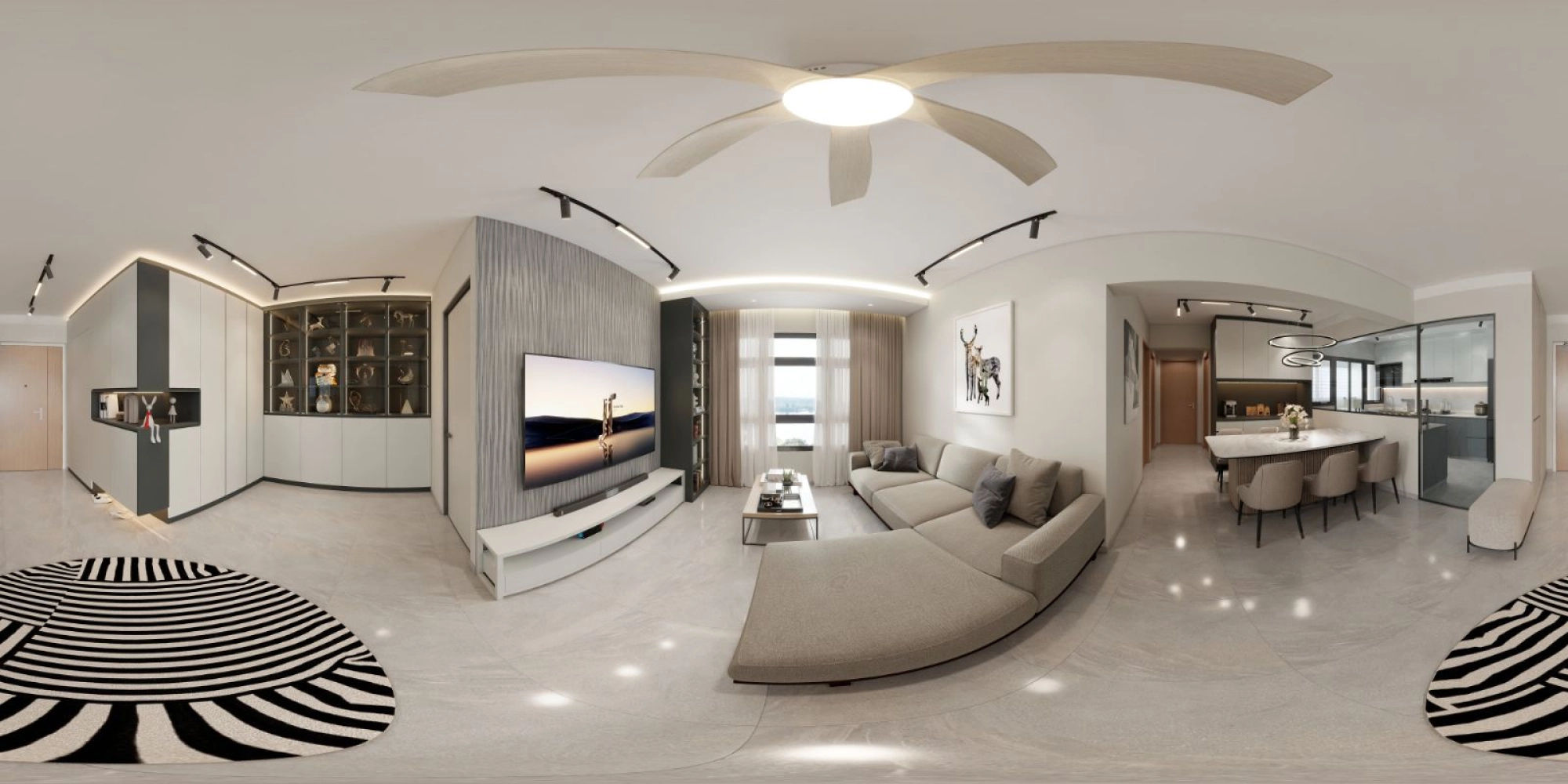
While fully immersive 6DoF spatial environments offer the ultimate sense of physical presence, a strategically deployed 360 virtual tour for architecture projects serves as an essential web-accessible layer in a developer’s digital funnel. Not every prospective buyer has immediate access to a high-end spatial headset, making browser-native, high-definition 360-degree interactive panoramas a critical component for initial property discovery.
A modern 360 virtual tour combines offline path-traced rendering quality with intuitive navigational controls. When paired with an interactive floor plan interface, prospective buyers can click specific room nodes, review architectural specifications, and transition seamlessly between day and night lighting presets. Furthermore, these 360-degree assets easily integrate into digital sales brochures, luxury real estate portals, and social media channels, capturing early buyer interest and driving qualified leads toward in-depth spatial walkthrough sessions.
| Visualization Medium | Primary Hardware Required | Key Strategic Advantage | Best Use Case |
|---|
| 6DoF Spatial VR Walkthrough | Apple Vision Pro, Meta Quest, PC VR | Absolute stereoscopic immersion and full user movement agency | Luxury off-plan sales suites & private VIP remote pitches |
| WebVR & Pixel Streaming | Any modern web browser (Mobile/Tablet/PC) | Zero deployment friction, global instant browser accessibility | International off-plan marketing portals & email campaigns |
| 360 Interactive Virtual Tour | Standard screens, tablets, smartphones | Ultra-fast loading with offline path-traced image fidelity | Broad digital marketing, residential listings, early discovery |
| Augmented Reality (AR) Overlays | AR Smart Glasses, iOS/Android Tablets | Overlays unbuilt structures onto real-world physical terrain | On-site land acquisition, stakeholder pitches, topping-out tours |
The Evolution to Generative Spatial Digital Twins and Beyond
As the real estate sector moves deeper into 2026, the boundaries between static 3D architectural visualization, spatial computing, and generative building information modeling continue to dissolve. The shift toward pre-construction VR digital twins is no longer governed merely by visual representation, but by real-time spatial intelligence.
Modern spatial digital twins integrate continuous daylighting simulations, computational microclimate models, dynamic biophilic elements, and live carbon footprint calculations directly into the interactive viewport. When an architect or buyer alters a material specification during a live spatial walkthrough, backend generative software recalculates both the visual reflection metrics and the embodied carbon impact of that material selection. This real-time synchronization elevates the spatial walkthrough from a pure presales marketing tool into an integrated platform for sustainable, human-centric property development.
Frequently Asked Questions
How do VR walkthroughs help sell off-plan properties?
A VR architecture walkthrough helps sell off-plan properties by replacing static 2D blueprints with immersive 1:1 scale environments. Buyers can physically explore unbuilt spaces, evaluate realistic daylighting conditions across different seasons, test custom interior finish options in real time, and gain absolute spatial clarity, which significantly reduces pre-sales buyer friction and accelerates sales velocity.
What are the best VR tools for real estate developers in 2026?
The best VR tools for real estate developers include Unreal Engine 5.5+ for high-fidelity photorealistic environments, OpenUSD data pipelines for seamless BIM model synchronization, and WebGPU-powered pixel streaming frameworks for frictionless browser access. Spatial computing headsets like the Apple Vision Pro and Meta Quest 3 provide ideal hardware platforms for immersive multi-user sales presentations.
How does a 360 virtual tour for architecture projects differ from full spatial VR?
A 360 virtual tour relies on pre-rendered, fixed-position panoramic camera nodes that users can look around from a stationary spot within a web browser. In contrast, full spatial VR (6DoF) renders the entire architectural environment dynamically in real time, allowing buyers to walk continuously through any part of the space, open doors, swap materials live, and experience true 3D spatial depth through a virtual reality headset.
Transforming Architectural Vision into Market Reality
The future of luxury real estate presales belongs to developers and architectural teams who eliminate the friction between conceptual design and buyer visualization. As spatial computing hardware becomes ubiquitous and OpenUSD workflows streamline the transformation of raw BIM data into photorealistic, interactive virtual reality environments, the traditional presales playbook is being permanently rewritten. By embracing USD-based digital twins, real-time material customization, and frictionless multi-platform deployment, luxury real estate developers can capture global capital, validate design choices with confidence, and convert off-plan interest into firm sales faster than ever before.

 VR & Tech