High-end luxury developments across global metropolises no longer rely solely on pre-rendered imagery or physical scale models to convert prospective buyers. In 2026, deploying a photorealistic VR architecture walkthrough has shifted from an innovative luxury perk to an essential deal-closing engine for multi-million-dollar off-plan developments. As spatial computing headsets become mainstream investment tools for real estate funds and private buyers alike, the boundary between physical architectural space and digital simulation has effectively dissolved.
Today's ultra-high-net-worth investors expect more than a passive visual presentation. They demand complete agency over their prospective environments: the ability to walk through an unbuilt penthouse at sunset, evaluate the shadow play of custom louvers, switch timber veneers in real time, and inspect structural spatial flow down to the millimeter. To meet these expectations, major developers and leading visualization studios are merging real-time game engines, spatial AI depth mapping, and pixel-streaming technology to redefine pre-construction sales.
Spatial Computing and WebXR: Why Interactive Experiences Dominate 2026 Marketing
For decades, architectural visualization operated on a offline rendering paradigm. Teams spent days ray-tracing high-resolution frame sequences with tools like V-Ray and Corona Renderer to produce static hero images or scripted walkthrough videos. While visually breathtaking, these mediums suffered from an inherent limitation: static imagery is non-interactive. If a prospective buyer questioned whether a master suite felt too enclosed or wondered how an open-plan living room integrated with a landscaped terrace, static assets could only offer static answers.
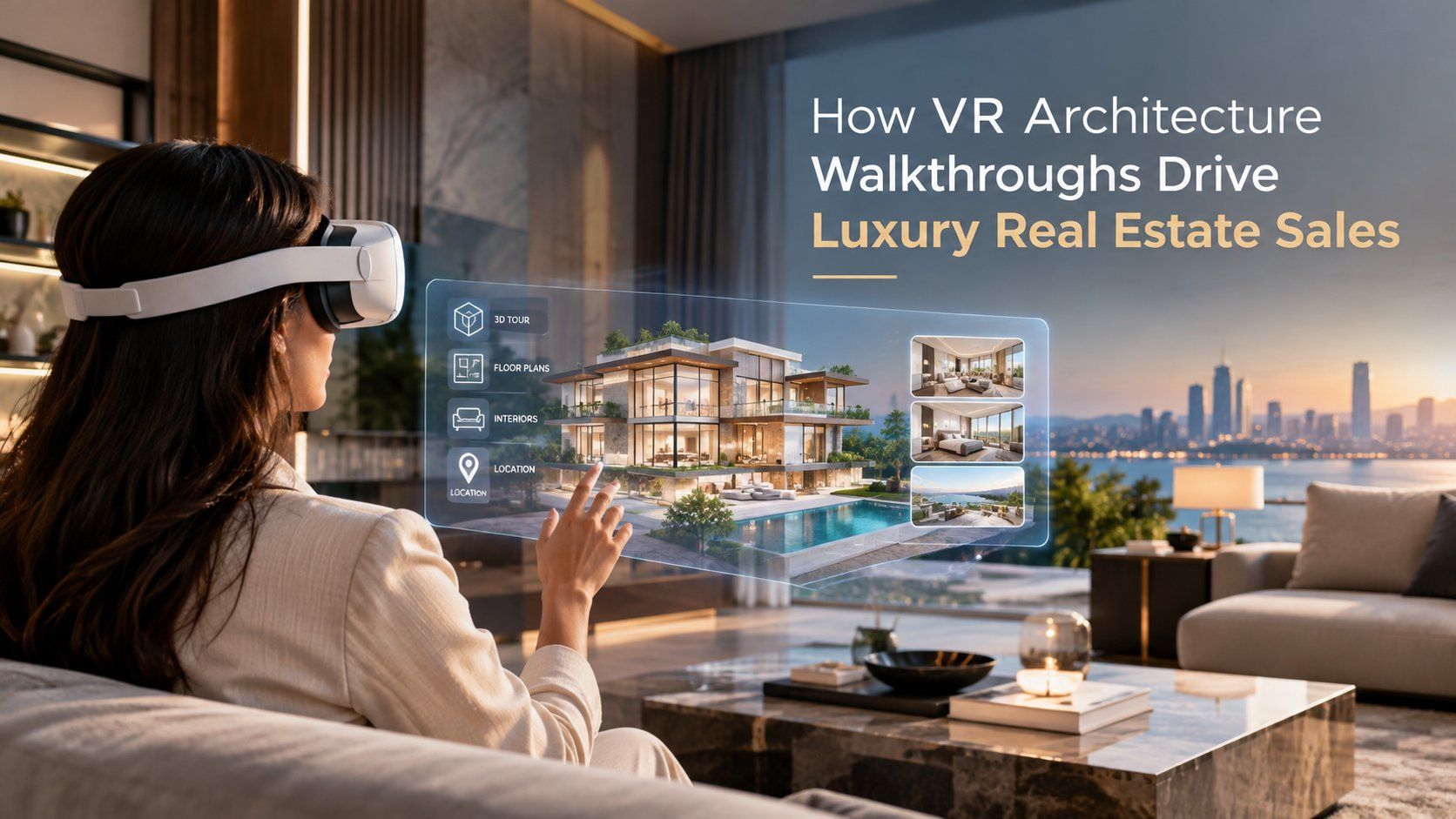
The arrival of dedicated spatial computing devices—led by the Apple Vision Pro and Meta Quest series—alongside browser-native WebXR frameworks has fundamentally altered this relationship. Modern interactive virtual reality allows prospective buyers to experience scale, volume, and materiality natively. Rather than viewing a property through a framed perspective, investors physically step inside the spatial geometry.
Simultaneously, cloud-streamed rendering engines running on Unreal Engine 5.5 and 6 enable pixel streaming directly to mobile browsers, tablets, and spatial headsets without demanding local processing power. A client in London can seamlessly explore a Miami waterfront tower via a lightweight browser link, stepping through a high-fidelity virtual environment backed by global server nodes. This friction-free accessibility has positioned cloud-based spatial tours as the benchmark for luxury international real estate releases.
How VR Walkthroughs Help Sell Off-Plan Properties
A VR architecture walkthrough helps sell off-plan properties by eliminating spatial ambiguity, accelerating buyer decision-making, and fostering an emotional connection to unbuilt real estate. By allowing buyers to walk through environments, customize finishes in real time, and evaluate scale, developers build confidence and significantly shorten sales cycles for luxury pre-construction projects.
Uncertainty is the single greatest obstacle in off-plan luxury acquisitions. Buyers struggle to interpret two-dimensional architectural floor plans or translate pre-rendered stills into a true sense of physical proportion. Spatial computing bridges this cognitive gap by presenting unbuilt spaces at true 1:1 scale. When an investor can walk to the edge of a virtual balcony and visually gauge the precise sightlines to the skyline, spatial hesitation disappears.
Key commercial mechanisms driving this sales acceleration include:
- Instant Customization and Material Selection: Integrated variant switchers allow clients to swap kitchen marble, millwork finishes, or loose furniture collections with zero latency, providing an immediate sense of custom ownership.
- Dynamic Environmental Simulation: Buyers can alter the time of day, seasonal sun angles, and artificial lighting schemes to observe how natural light illuminates deep floor plates throughout the year.
- Spatial Agency and Emotional Attachment: Navigating an environment at one's own pace creates a psychological sense of residency far stronger than passive video viewing.
- Remote Global Reach: International buyers can participate in synchronized, multi-user guided walkthroughs with sales directors without taking cross-continental flights.
According to coverage in Forbes Real Estate, spatial computing and immersive visualization platforms are directly responsible for compressing pre-lease and off-plan sales velocity across Tier-1 metropolitan markets.
The Best VR Tools for Real Estate Developers in 2026
The best VR tools for real estate developers in 2026 include cloud-streamed Unreal Engine spatial applications, Apple Vision Pro spatial computing environments, WebXR browser frameworks, and real-time neural render engines like Chaos Vantage. These platforms enable photorealistic, multi-user spatial exploration without requiring heavy client-side hardware or complex app installations.
Choosing the correct technological stack depends heavily on the sales distribution channel—whether the asset is being showcased in a dedicated physical presentation center or distributed globally to private devices.
1. Unreal Engine & Pixel Streaming Networks
Unreal Engine remains the gold standard for high-fidelity realtime architectural visualization. Incorporating dynamic global illumination (Lumen), virtualized geometry (Nanite), and real-time neural denoisers, Unreal Engine generates cinema-grade graphics at high framerates. Paired with Pixel Streaming services, developers can host complex executable builds on GPU cloud servers and stream interactive experiences directly to client devices via standard web links.
2. Apple Vision Pro Spatial Apps
Designed for ultra-high-end sales galleries and private VIP client presentations, native visionOS applications leverage dual-4K micro-OLED displays and precise eye-and-hand tracking. These applications allow users to blend high-resolution passthrough with full immersive spatial models, toggling seamlessly between viewing a physical tabletop scale model via augmented reality and stepping directly into a full-scale digital twin.
3. WebXR and Interactive Web Platforms
For broad reach across international marketing campaigns, WebXR frameworks provide cross-platform spatial capabilities directly within standard web browsers. WebXR allows users to view an interactive floor plan on a desktop or tablet and instantly switch into an immersive head-mounted display mode with a single tap, requiring zero friction or third-party app installations.
4. Real-Time Neural Render Engines
Tools such as Chaos Vantage and D5 Render have integrated real-time neural render nodes directly into CAD and BIM workflows. By combining path-tracing algorithms with generative AI diffusion layers, these render engines allow visualization studios to translate complex Revit, Rhino, and Archicad models into dynamic VR environments in hours rather than weeks.
Evolving Beyond the 360 Virtual Tour for Architecture Projects
While a traditional 360 virtual tour for architecture projects relies on fixed pre-rendered camera nodes, modern spatial computing offers true six-degrees-of-freedom (6DoF) movement. This allows prospective buyers to freely roam every room, inspect architectural joinery up close, and manipulate lighting scenarios rather than leaping between pre-determined photographic points.
Early digital real estate tools relied heavily on panoramic sphere nodes captured from rendered camera positions. Although cost-effective, these legacy tours restricted movement to static jumping points, creating a disjointed "teleportation" feeling that failed to convey structural flow. Modern pre-construction VR built on 6DoF game engines lets users walk naturally, sit down on virtual furniture, look around architectural columns, and perceive true volumetric depth.
As highlighted in architectural publications like ArchDaily, the industry’s narrative focus has shifted entirely from presenting isolated architectural static imagery to composing fully navigable, spatial narratives.
Designing a VR Architecture Walkthrough: Technical Workflows for 2026
Creating an uncompromising, ultra-luxury virtual environment requires a sophisticated pipeline that bridges traditional BIM geometry with modern realtime optimization techniques. The process demands meticulous attention to polycounts, texture memory, real-time lighting physics, and UI/UX design.
Phase 1: BIM Optimization and Retopology
Architectural BIM models (Revit, ArchiCAD) are inherently heavy, packed with non-visual metadata, internal pipework, and unoptimized high-polygon families. Visualization specialists perform rigorous retopology—cleaning geometry, stripping hidden CAD elements, and recreating clean, manifold quad meshes optimized for real-time rasterization and ray-tracing nodes.
Phase 2: PBR Material Creation and Spatial AI Texturing
Luxury architecture relies heavily on tactile, high-grade materials: hand-honed travertine, brushed champagne metals, fluted oak paneling, and low-iron architectural glass. Using Physically Based Rendering (PBR) texture pipelines augmented by generative AI depth-mapping, studios author multi-layered materials featuring accurate roughness, normal, displacement, and metallic maps that react dynamically to shifting light sources.
Phase 3: Real-Time Lighting and Neural Upscaling
Lighting dictates emotional resonance. Studios configure real-time global illumination systems combined with neural upscaling filters. Sky atmosphere models simulate geographic sun positions precisely based on project latitude and longitude, allowing potential buyers to evaluate exact shade patterns across outdoor pool decks and interior living spaces.
Phase 4: Multi-User Collaboration and AI Concierge Integration
Modern commercial walkthroughs support multi-user network sessions. A sales agent located in London can lead an avatar-based tour for a client in Tokyo, highlighting architectural features with spatial laser pointers, switching floorplan layouts, and triggering dynamic spatial audio annotations. Advanced setups incorporate spatial AI sales concierges capable of answering technical specification questions in natural language in real time.
Spatial computing does not merely display architecture; it simulates the lived experience of space before a single foundation pile is driven into the ground.
Integrating Augmented Reality Architecture on Active Construction Sites
While fully virtual environments serve off-plan sales during initial marketing phases, augmented reality architecture is transforming site visits and spatial verification during construction. Using spatial headsets or high-performance mobile devices, sales teams and future homeowners can stand on an unfinished concrete floor plate and overlay photorealistic 3D interior finishes directly onto raw structural slabs.
This passthrough capability allows buyers to look through unfinished window openings and see exact framing, furniture placement, and millwork overlays positioned precisely in real-world space. On site, site engineering teams simultaneously leverage AR overlays to verify structural MEP routing against green-building carbon goals and mass-timber structural frameworks.
Frequently Asked Questions
How do VR architecture walkthroughs impact conversion rates for off-plan real estate?
By providing complete spatial transparency, high-fidelity real-time interactive walkthroughs significantly reduce buyer hesitation and purchase cycles. Prospective buyers gain total clarity regarding scale, views, and layout, resulting in higher qualified conversion rates and reduced reliance on physical model residences.
What is the difference between a 360 virtual tour for architecture projects and interactive spatial computing?
A 360 virtual tour relies on pre-rendered, fixed panoramic camera positions that users hop between linearly. Interactive spatial computing offers complete six-degrees-of-freedom (6DoF) movement, allowing users to walk anywhere naturally, interact with objects, modify finishes, and experience realistic dynamic lighting in real time.
What hardware is required to experience WebVR architecture tours?
WebVR and cloud-streamed architectural applications are hardware-agnostic. Users can interact via standard web browsers on desktop computers, tablets, and smartphones, or wear dedicated spatial headsets such as the Apple Vision Pro, Meta Quest 3, or enterprise XR displays for fully immersive 3D spatial navigation.
The Permanent Shift in Architectural Visualization
The transition from static rendering to spatial computing represents a fundamental evolution in how architectural design is communicated, evaluated, and monetized. Static imagery will always maintain its place in artistic editorial feature layouts, but interactive, photorealistic environments have claimed the central stage in luxury real estate development. By placing prospective buyers inside unbuilt real estate through an immersive, responsive VR architecture walkthrough, developers eliminate guesswork, bridge international distances, and establish emotional connections that transform ambitious architectural visions into closed transactions.
"


 VR & Tech