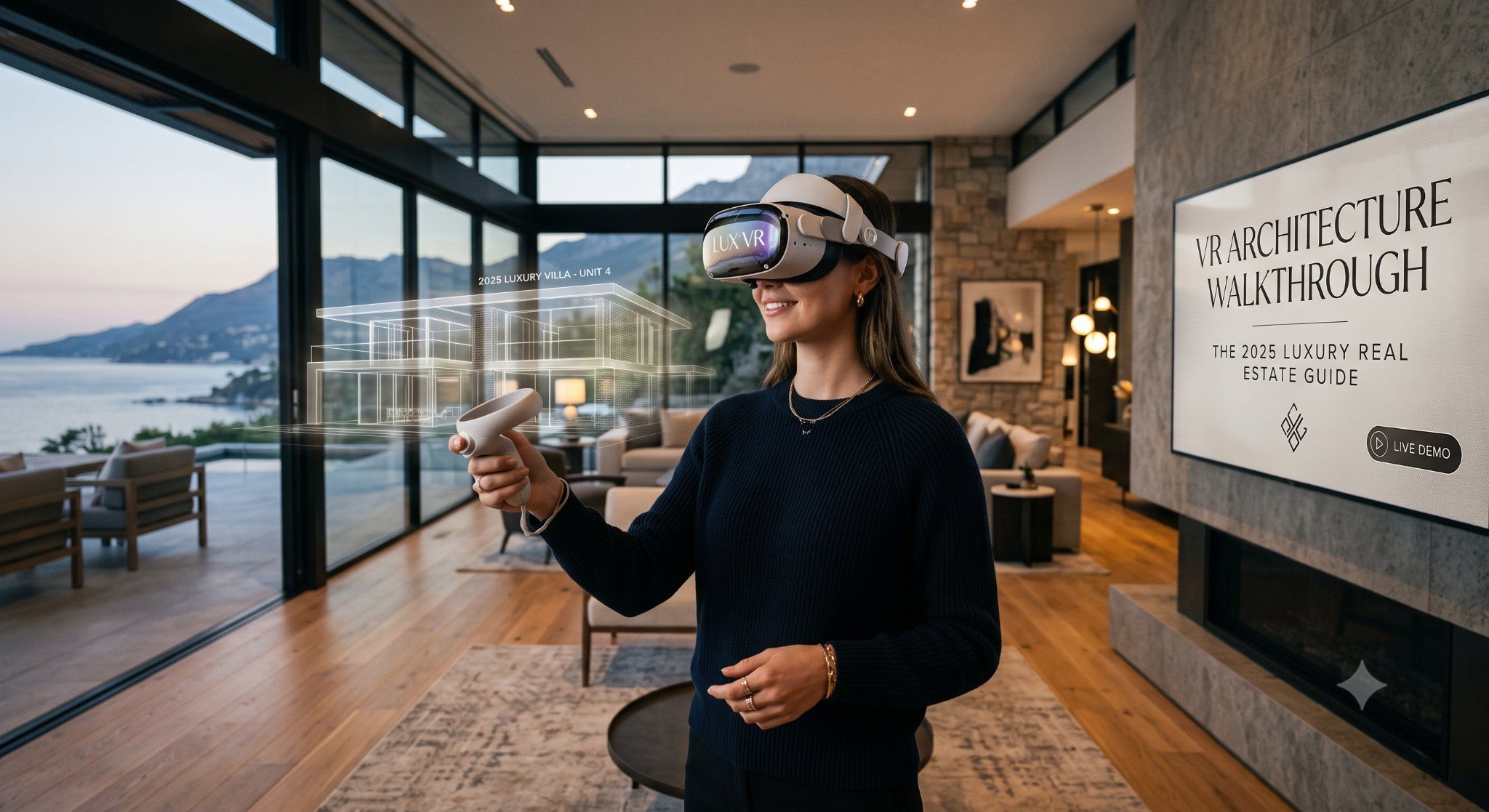
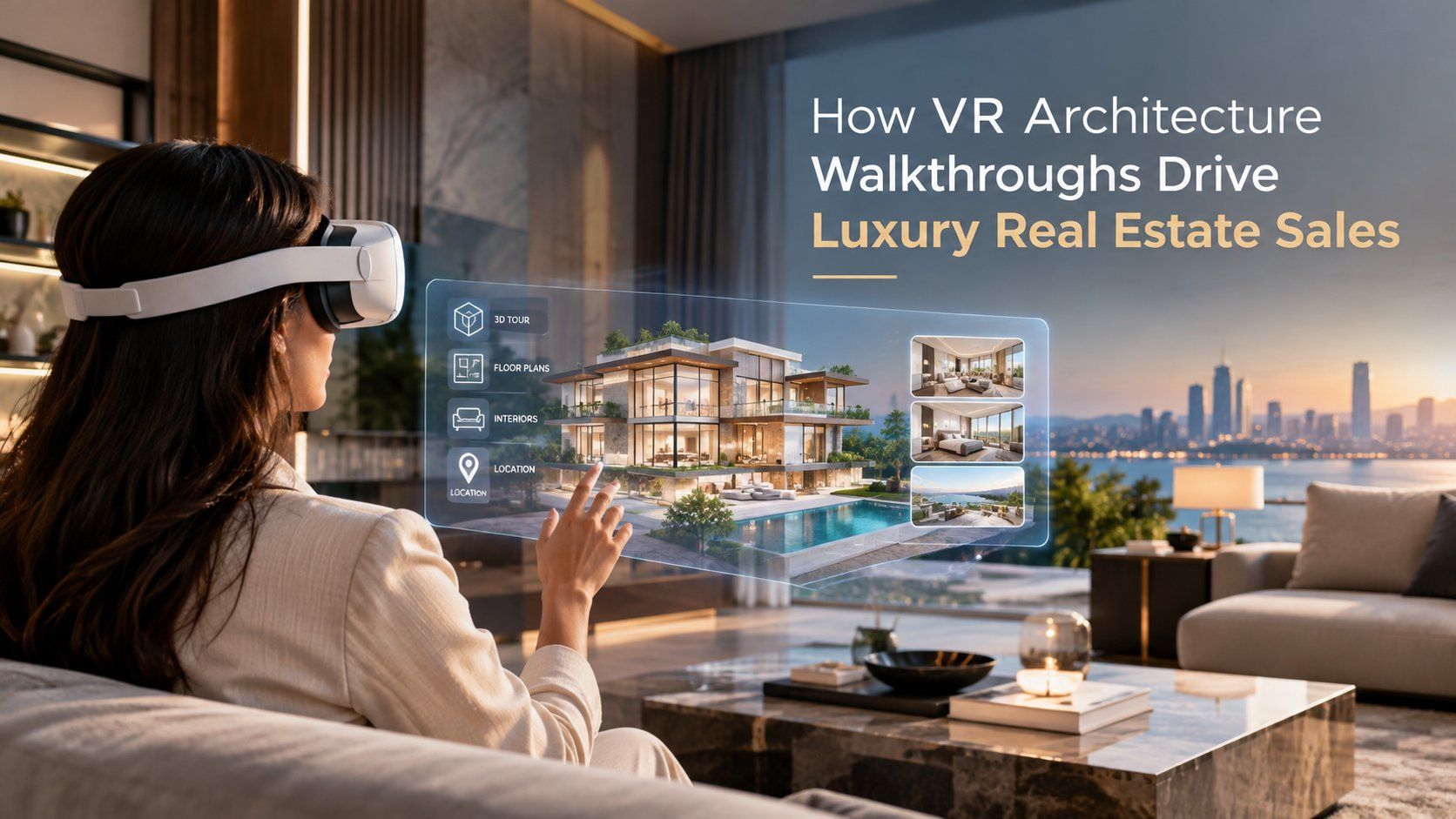
Deploying an immersive VR architecture walkthrough has evolved from an experimental luxury perk into an essential sales infrastructure for high-end off-plan real estate developments. In an international market where multi-million-dollar residential units are purchased prior to ground-breaking, static architectural renderings and pre-rendered flythrough animations no longer suffice. Today’s global investors demand real-time spatial agency—the power to step inside an unbuilt sky villa, assess volumetric proportion, test natural daylighting across seasons, and personalize interior finishes on the fly.
As spatial computing hardware matures alongside high-performance graphics engines, real-time 3D digital twins are fundamentally altering how luxury developments are designed, marketed, and acquired. By bridging the cognitive gap between two-dimensional floor plans and real-world spatial experience, immersive technologies are accelerating pre-construction sales velocity while reducing design iteration cycles for masterplan developers and architects worldwide.
The 2026 Spatial Computing Shift: Beyond Static 3D Visualizations
The architectural visualization industry has reached a pivotal juncture. For decades, offline rendering engines such as V-Ray and Corona Renderer set the benchmark for photorealism, producing pixel-perfect static imagery that graced luxury sales brochures. However, these static assets remain inherently passive. They offer curated perspectives selected by the artist, often leaving buyers uncertain about spatial flow, sightlines, ceiling heights, and atmospheric lighting conditions.
The convergence of WebGPU browser standards, cloud-streamed pixel rendering, and consumer-accessible spatial headsets has elevated expectation standards across international real estate markets. As noted by analysts at Forbes Real Estate, ultra-high-net-worth individuals purchasing off-plan properties prioritize confidence and certainty over speculative promises. Real-time spatial computing addresses this demand directly by delivering true volumetric presence.
Rather than relying on static previews, modern luxury sales suites deploy real-time digital twins built within Unreal Engine 5.5 and Unity Industry. These environments allow prospective buyers to move unconstrained through a project, experiencing atmospheric volume, dynamic reflections via real-time ray tracing, and exact spatial acoustics. The shift is clear: high-end property marketing has transitioned from visual presentation to real-time spatial immersion.
Why the Modern VR Architecture Walkthrough Prevails in Luxury Off-Plan Sales
Understanding how immersive technologies influence buyer behavior requires looking closely at the psychological mechanics of high-value purchases. When a client evaluates pre-construction real estate, spatial doubt represents the single greatest point of sales friction.
How VR walkthroughs help sell off-plan properties
A VR architecture walkthrough helps sell off-plan properties by eliminating spatial ambiguity and creating immediate emotional connection. By allowing buyers to walk through unbuilt spaces at true 1:1 scale, test dynamic lighting across different times of day, and interact with architectural finishes, virtual reality builds buyer confidence, accelerates decision-making timelines, and significantly drives up pre-construction sales conversion rates.
When a prospective buyer puts on a spatial computing headset or interacts with a cloud-streamed WebVR environment, several key psychological and operational dynamics take effect:
- Scale and Volumetric Comprehension: 2D architectural drawings and even standard 3D renders fail to convey true spatial volume. Inside a real-time virtual simulation, double-height ceilings, ocean sightlines, and room transitions are felt instantaneously, validating the value of premium square footage.
- Emotional Spatial Ownership: Immersion triggers spatial memory in the brain similar to physical presence. When buyers can open balcony doors, observe how afternoon sun filters through custom louvers, or step out onto a virtual private terrace, they begin forming emotional attachment long before concrete is poured.
- Dynamic Customization and Personalization: Real-time engines empower clients to swap marble finishes, inspect alternative joinery packages, or reconfigure lighting layouts in real time. This immediate feedback loop eliminates endless revision cycles and speeds up client sign-off.
- Seamless Global Reach: With cloud-pixel streaming platforms, an international investor in Singapore or London can participate in a real-time guided walkthrough of a Miami penthouse alongside the masterplan architect, eliminating geographical barriers to capital commitment.
"Spatial presence in pre-construction visualization converts passive viewers into active decision-makers. When a client experiences structural volume and natural light at true scale, the purchasing conversation shifts from spatial reassurance to property customization."
Technical Foundations: Neural Rendering, WebVR, and Digital Twins
Delivering an uncompromised spatial experience requires sophisticated real-time technical architecture. The era of low-polygon, stuttering virtual environments has been replaced by enterprise-grade graphics pipelines that rival high-end cinematic offline renders.
Unreal Engine 5.5 Nanite and Lumen Integration
The backbone of modern interactive virtual reality in architecture is built upon real-time geometry and lighting systems. Systems like Unreal Engine’s Nanite allow visualization studios to import high-poly BIM (Building Information Modeling) assets directly from Revit, Rhino, or Archicad without manual retopology or loss of micro-detail. Coupled with Lumen—a fully dynamic global illumination and reflections system—architects can simulate real-world daylighting, atmospheric bounce, and artificial lighting arrays instantly as sun angles are adjusted.
WebVR Architecture and Browser-Based Streaming
While dedicated spatial computing headsets offer maximum immersion, accessibility across devices remains critical for broad-scale 360° VR walkthroughs. Advanced studios now deploy WebVR architecture powered by WebGPU and cloud pixel streaming services (such as PureWeb or Furioos). This setup enables high-fidelity 3D environments to run on remote GPU servers and stream directly into standard web browsers on tablets, laptops, or touchscreens in sales galleries, requiring zero client-side installation or heavy hardware.
Gaussian Splatting and Neural Spatial Capture
A major advancement in 2026 is the integration of 3D Gaussian Splatting and neural radiance fields (NeRFs) into real-time architectural environments. By combining photogrammetric drone scans of actual site context with CAD models of proposed luxury towers, developers can place their virtual buildings into photorealistic, real-world context models. Buyers looking out from a 40th-floor virtual balcony see the real city skyline captured with exact optical clarity, complete with accurate depth of field and environmental ambient lighting.
Selecting the Best VR Architecture Walkthrough Tools for Real Estate Developers
Real estate developers and architecture firms must choose technical stacks that balance spatial fidelity, team workflow integration, and deployment flexibility across marketing platforms.
Best VR tools for real estate developers
The best VR tools for real estate developers in 2026 combine real-time rendering power with flexible multi-platform deployment. Unreal Engine 5.5 leads for high-fidelity custom digital twins; Twinmotion and Chaos Vantage excel at rapid architectural synchronization from BIM software; and platforms like Varjo Teleport and ShapeSpark power accessible web-based immersive presentations for global luxury sales.
To help development teams select the right software architecture, the primary real-time spatial platforms are structured around distinct operational use cases:
- Unreal Engine 5.5: The benchmark for flagship luxury sales suites. Offers complete control over dynamic lighting, real-time material switches, multi-user networked walkthroughs, and ultra-high-definition headset streaming.
- Twinmotion: Ideal for rapid design iteration and mid-scale developments. Plugs directly into Archicad, Revit, and SketchUp via live links, allowing architectural teams to export interactive environments in minutes.
- Chaos Vantage: Enables ray-traced real-time exploration of massive V-Ray scenes without complex engine conversions, preserving original architectural materials and light setups.
- Shapespark / WebXR Engines: Purpose-built for low-latency, WebVR browser delivery. Optimized for light-footprint interactive floor plans and ambient baked lighting accessible on any mobile device.
Integrating Sustainability: Climate Resilience and Digital Material Passports
In addition to driving pre-construction sales, real-time spatial digital twins are becoming integral to sustainable design verification and whole-life carbon accounting. Environmental mandates across North America, Europe, and Asia require luxury developments to demonstrate rigorous environmental performance prior to municipal approval.
As featured in coverage by ArchDaily, top architectural practices leverage interactive digital twins to test passive solar strategies, kinetic facade performance, and natural ventilation patterns within real-time simulation engines. By simulating seasonal solar orientation within the spatial twin, designers optimize shading structures and window-to-wall ratios long before construction begins, minimizing operational energy demand.
Furthermore, digital material passports—which track the embodied carbon, provenance, and recyclability of structural mass timber, low-carbon concrete, and facade assemblies—are increasingly linked directly to real-time 3D models. Prospective luxury buyers can click on custom oak timber cladding or acoustic wall paneling within an interactive floor plan to review its environmental origin, embodied carbon footprint, and circular economy credentials, appealing to environmentally conscious investors.
Implementing Immersive Real Estate Sales Galleries
To maximize return on investment, luxury property developers structure their sales galleries around multi-tiered spatial engagement strategies. Relying on a single technology format can alienate certain demographic segments; a layered digital approach ensures broad engagement across all buyer preferences.
1. The Physical Spatial Suite (Immersive LED Walls & Headsets)
High-end sales centers combine high-resolution micro-LED curved video walls with high-grade spatial headsets. The LED wall provides a shared visual baseline for groups or families, while individual clients can step into dedicated VR bays for personalized 1:1 scale walkthroughs guided by sales executives.
2. The Web-Native Interactive Portal
For international outreach, developers embed cloud-streamed WebVR modules into official project portals. Remote buyers can freely explore unbuilt floor plans, switch between day and night lighting modes, test alternative furniture configurations, and measure custom spatial dimensions directly inside their browser window.
3. Augmented Reality Site Overlays
On-site sales experiences leverage tablet-based or wearable augmented reality architecture. When prospective buyers visit the physical plot, AR overlays project the completed architectural form onto the existing terrain at scale, framing view corridors and highlighting neighborhood infrastructure in real time.
Frequently Asked Questions
How does a 360 virtual tour for architecture projects differ from a real-time VR walkthrough?
A 360 virtual tour for architecture projects relies on static, pre-rendered spherical 360-degree panoramic imagery linked along fixed camera nodes. While accessible, movement is restricted to predetermined viewpoints. In contrast, a real-time VR architecture walkthrough renders the environment dynamically, granting users complete six-degrees-of-freedom (6DoF) movement to walk anywhere, inspect details up close, adjust lighting, and reconfigure interior finishes instantly.
What internet infrastructure is required to host browser-based WebVR architectural models?
Browser-based WebVR architecture utilizes server-side cloud pixel streaming. The 3D scene is rendered on remote enterprise GPU servers, streaming only the high-definition video frame feed to the user’s browser. Consequently, end-users only require a standard high-speed broadband connection (minimum 15–25 Mbps) without needing expensive specialized graphics hardware on their local device.
Can real-time architectural digital twins be integrated into ongoing facility management after construction?
Yes. The real-time spatial computing model developed during design and sales serves as the foundational geometric framework for building operations. Post-construction, the spatial digital twin connects to IoT sensors, building management systems (BMS), and maintenance tracking software to monitor real-time energy use, occupancy density, and structural mechanical systems throughout the building's lifecycle.
The Future of Spatial Real Estate Sales
The integration of real-time spatial computing, neural graphics rendering, and interactive digital twins marks a permanent evolution in how architectural ideas are communicated and commercialized. The era of asking clients to visualize multi-million-dollar spaces from static two-dimensional renders and conceptual sketches is rapidly closing.
By putting hyper-realistic spatial experiences into the hands of prospective buyers, developers remove uncertainty, shorten global sales lifecycles, and raise the standard for design precision. As spatial computing hardware becomes lighter, more powerful, and fully integrated into daily workflow, real-time spatial immersion will remain the definitive standard for luxury architectural marketing and spatial design excellence worldwide.

 Architecture & Design